
The Event Has Concluded
Thank you for joining us at Eyes On Retina 2026.
Eyecare professionals from across the industry came together to take on some of the most pressing challenges in retina care today. Leading retina specialists and clinicians shared practical strategies for using multimodal imaging to predict AMD progression and detect neovascularization, evaluating peripheral retinal lesions with OCT and ultrawidefield imaging, and telling a choroidal nevus apart from melanoma. From extended-duration therapies in nAMD and DME and new approaches to diabetic retinopathy, to photobiomodulation for dry AMD, neuro-ophthalmic perspectives on retinal arterial occlusive disease, and pediatric retinal grand rounds, the program was built to help optometrists close their biggest gaps and grow.
We hope you're leaving with a clearer sense of where to focus, what to change, and which strategies you can put into practice right away. Above all, we hope you feel ready to detect, manage, and refer retinal disease with greater confidence.
And this is just the beginning. Continue your learning with our growing library of on-demand CE, future events, and expert-led educational content.
Keep your Eyes On what's next in retina.

Refresh Your Screen with Stunning Eyecare-Inspired Wallpapers
Your phone deserves a glow-up. We made three wallpapers for the eyecare-obsessed — bold enough to stop the scroll, thoughtful enough to actually mean something. Choose your favorite and make every unlock feel a little more you.

Unlock the 2026 Retina Report: A Clearer View of What’s Next
Be among the first to see how hundreds of optometrists are diagnosing, managing, and co-managing retinal disease today. The 2026 Retina Report reveals the imaging technologies gaining ground, the emerging therapies capturing clinical interest, and the barriers still standing between patients and new treatments. Debuting at Eyes On Retina 2026, the report brings the future of retina care into sharp focus, because the best outcomes start with seeing the full picture.

Optometry Giving Sight: Our Exclusive Charity Partner
Join us in making a global impact through Optometry Giving Sight, a charity dedicated to preventing blindness and vision impairment by funding sustainable eye care initiatives worldwide. Your donation helps train eye care professionals, establish vision centers, and expand access to care in underserved communities. Together, we can change lives through the gift of sight.

Join the World Sight Day Challenge with Optometry Giving Sight
Optometry Giving Sight (OGS) is on a mission to make eye care available to everyone, everywhere — and they've already transformed over 15 million lives to prove it. Powered by the generosity of the optometry community, OGS has built 14 optometry schools, established 200+ vision centers, and trained 14,000+ optometry professionals across 70+ countries. This World Sight Day Challenge, your gift helps fund the next grant, the next vision center, the next life changed. Because it's not just sight — it's an entire future.
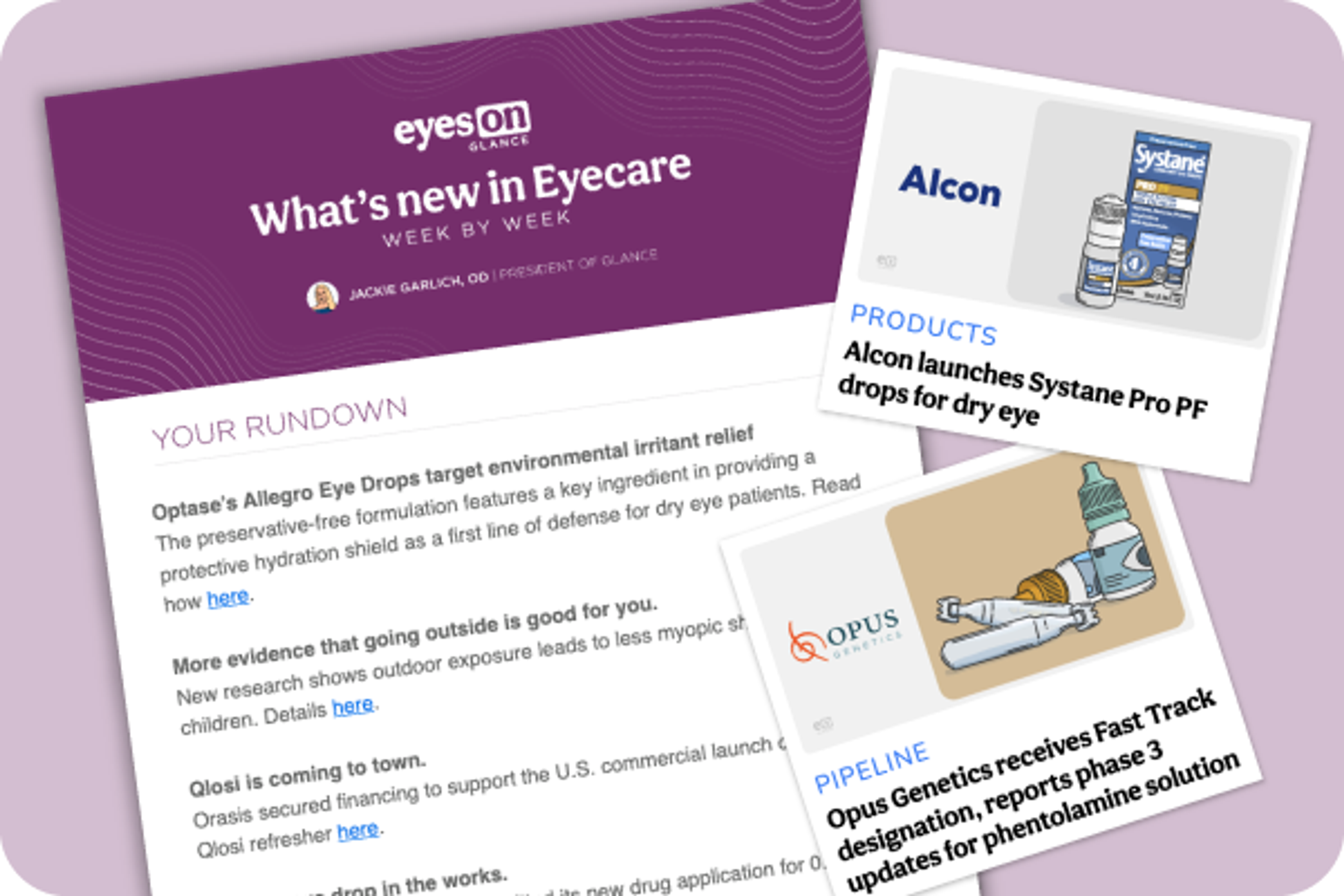
Stay Sharp with Weekly Eyecare Insights
You're busy. Glance gets it. Dry eye expert Jackie Garlich, OD, FAAO does the reading so you don't have to — distilling the week's most important developments in optometry and ophthalmology into a quick, clinically sharp email you'll actually look forward to. Plus, fresh content hits the site daily so you're never more than a click away from what's new.

Stay Tuned for the Latest FREE On-Demand CE/CME Courses
Tailored for ambitious optometrists and ophthalmologists, Eyes On Eyecare Courses offer concise, on-demand lessons you can take at your own pace. With new topics released each month in both CE/CME and Non-CE/CME formats, you'll gain access to cutting-edge education designed to keep you at the forefront of the latest advancements in eyecare. Stay ahead of the curve with expert-led insights and techniques.

Managing Geographic Atrophy in 2026
GA doesn't wait — and neither should your referrals. Dr. Talia R. Kaden breaks down GA's OCT diagnostic criteria, the two FDA-approved complement inhibitors now available, and the investigational therapies in the pipeline. Through real patient cases, she tackles the hard questions: when to start treatment, whether to treat both eyes, how to manage conversion to neovascular AMD, and how to distinguish GA from other atrophic disease. With 100% of GA patients reporting reading difficulty, the case for earlier referral has never been clearer.

Advances in Stem Cell Therapy for Vision Restoration
What if we could do more than slow GA — what if we could reverse it? In this Retina Mentor Moments conversation, Dr. John Kitchens sits down with Dr. Theodore Leng of Stanford to explore stem cell therapy for vision restoration in geographic atrophy. Dr. Leng shares early phase 1 data showing patients gaining up to 28 letters of vision through subretinal stem cell transplants — a fundamentally different intervention from complement inhibitors, which only slow progression. He also covers his work developing EYE-Llama, an AI model fine-tuned for ophthalmology.

ERLYDEX Study Results of Dexamethasone Implantation in Clinical Practice
When anti-VEGF stops working for your DME patients, what's the next move? Drs. Rishi Singh and Baruch Kuppermann dig into ERLYDEX — a retrospective analysis of 167 suboptimal anti-VEGF responders — comparing continued anti-VEGF against a switch to dexamethasone implant (OZURDEX). Nearly 45% of the OZURDEX group gained 10 letters at weeks 4 and 12, versus under 10% in the continued anti-VEGF group. Dr. Kuppermann also walks through his real-world decision framework for knowing when to make the switch.

Clinical Hallmarks that Define MacTel Progression
MacTel type 2 is easy to miss — and costly to overlook. Dr. Dilsher Dhoot maps the key imaging signatures of this bilateral neurodegenerative disease: ellipsoid zone loss on OCT, juxtafoveal leakage on fluorescein angiography, and the subset of patients who progress to subretinal neovascularization. He addresses the practical challenge of a disease where BCVA stays deceptively intact while central field function erodes, and covers the recent FDA approval of ENCELTO — the first approved treatment for non-proliferative MacTel type 2.

Connect & Engage: Networking with Ease
Have you heard about our new Peer-to-Peer (P2P) chat feature? Connect with colleagues and sponsors 1:1 at your convenience. Click the black bubble in the bottom right corner of any event page (excluding the FAQ page) to start chatting. Want another raffle ticket? Engage in P2P chats with five people before the Closing Remarks and receive an extra raffle code. Email us at events@eyesoneyecare.com to claim it once you've completed your chats.